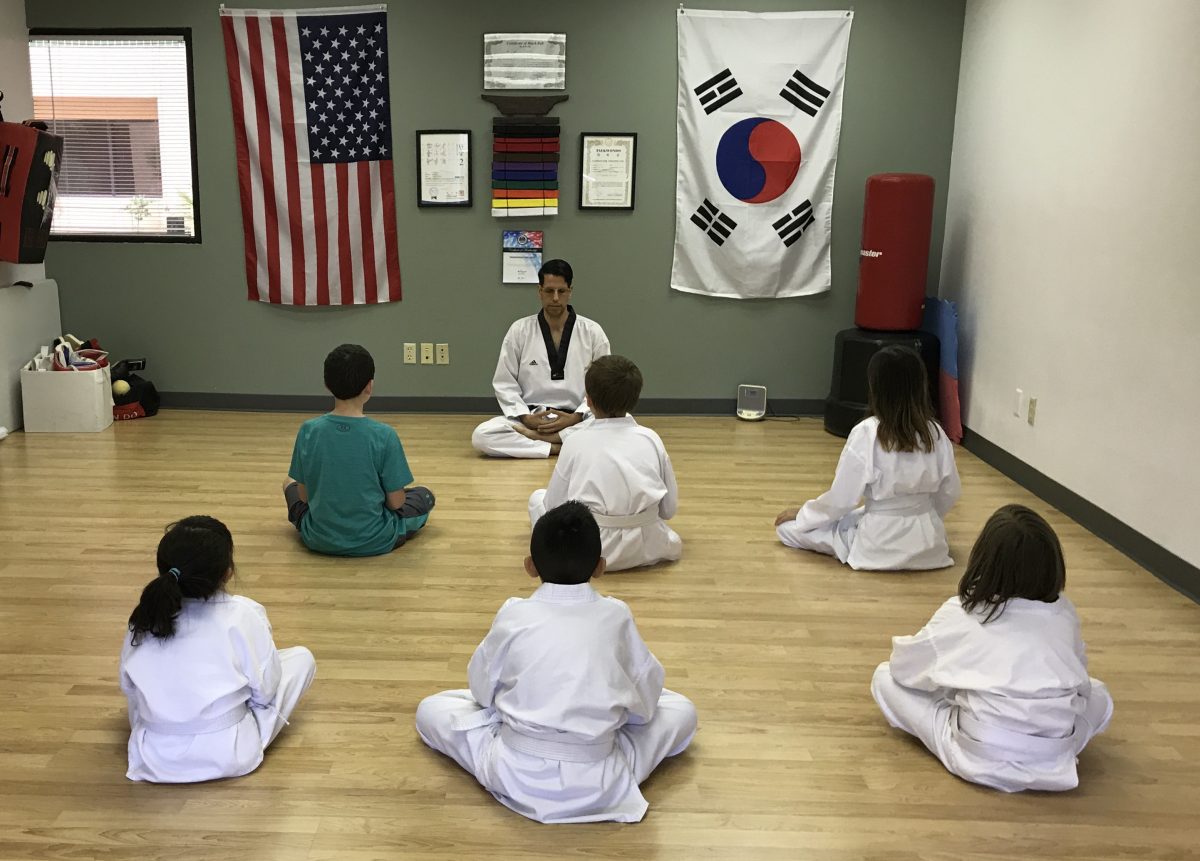
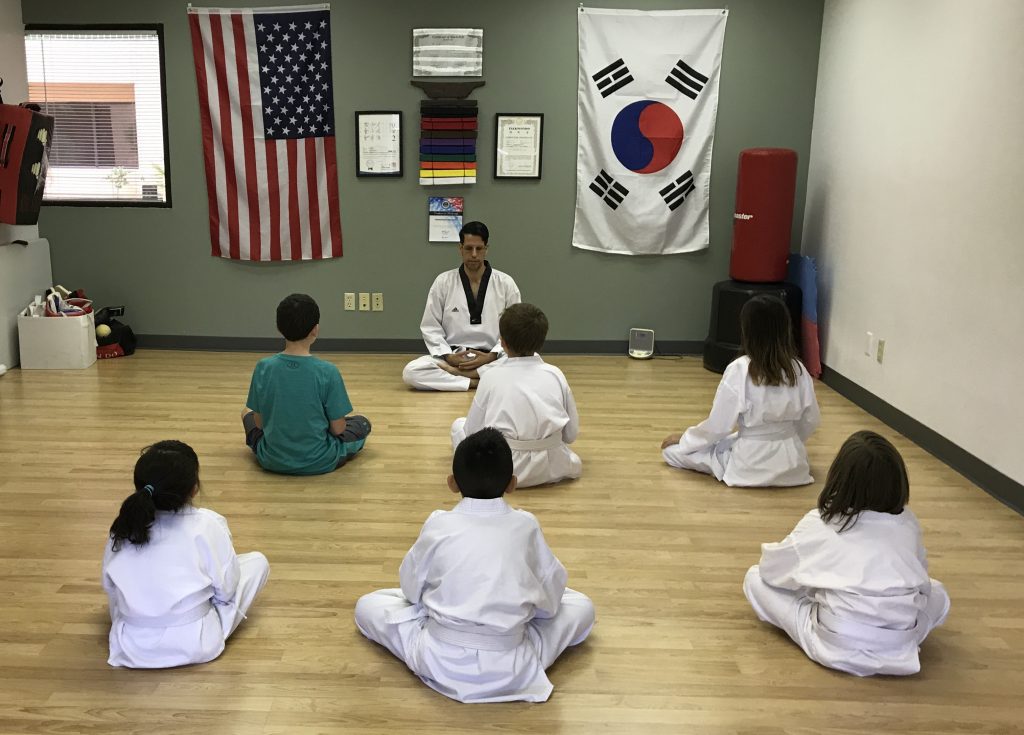
Meditation is a mental exercise that has been taught and practiced in both traditional and sport Taekwondo dojangs across the world. Meditation has also been featured in countless martial arts movies such as The Karate Kid and USA Taekwondo has written articles about “Clearing Your Mind Using Meditation.” It’s important to know that there are various styles of meditation but for the sake of brevity, we will discuss “mindfulness meditation,” which is the stye taught to students at Taekwondo Wellness.
So what exactly is mindfulness mediation and how can it benefit your martial arts practice?
“Mindfulness means paying attention in a particular way: on purpose, in the present moment, and nonjudgmentally.” ~ Jon Kabat-Zinn.
Thus, mindfulness meditation is the practice of intentionally paying attention to the present moment without judgment or criticism. Mindfulness can be practiced both formally and informally. Formal practice is done by setting aside a specified amount of time (e.g., 5, 10, 30 minutes per day, etc) to practice mindfulness while informal practice is done throughout one’s day by simply paying attention at various moments during one’s day (e.g., while eating, showering, walking, training, etc).
How to Practice
- For formal practice: Get into a comfortable position. Can be sitting with legs crossed, sitting in a chair or even laying down. For informal practice simply do steps 2-3 throughout your day for moments at a time.
- Close your eyes and inhale. Focus your attention on your breath. Notice if your shoulders, chest, or abdomen move as you inhale or exhale. Continue to breathe in and out at your natural rhythm.
- You will soon notice that our mind naturally begin to wonder and experience all sorts of thoughts and feelings and our senses are heighten. For example, you may notice sounds that were in the background that you hadn’t noticed before. This is normal. The task is to simply notice your experience without judgement or criticism and return your attention to your focus of attention (usually one’s breathe but can also be to other things like our sense of sound).
Reasons to Practice
- Relaxation is a major benefit of this sort of meditation practice. Sport psychologists have shown that anxiety decreases performance in their research. Thus, if you’re nervous before a promotion test, a competition or even a challenging drill in class, meditation is the antidote!
- Meditation helps regulate our energy levels. Research has also found that people have an optimum level of energy where they perform at their best. However, if one’s energy is too high, it becomes difficult to concentrate whether it is poomsae, sparring or breaking. Meditation practice lowers our heart rate, which in turn lowers our energy levels allowing us to concentrate and perform better.
- Focus is another added benefit of a regular meditation practice. Let me explain, in how to practice step 3 above, the mind wonders and the task is to return to our chosen focus of attention without judgment. This exercise of being distracted and returning attention, followed by being distracted and returning attention gives us the power to focus our attention to what we choose rather than what the brain wants to experience at that moment. This is vital whether it is in a self defense situation or a competition as one would want to focus on the actions that will lead to the desired outcome rather than on emotions such as fear that may leave us frozen in place.
- There are many more evidenced-based benefits to mindfulness, just see this article by the American Psychological Association. For example: Reduced rumination, stress reduction, boosts to working memory, focus, less emotional reactivity, more cognitive flexibility and relationship satisfaction are benefits demonstrated through research.
Now you know how and why to incorporate a practice meditation into your martial arts training. The key, like in martial arts training, is consistency. The more you practice meditation, the more useful it will when you need it. So I recommend you practice at the end of every class, even if it is just for a minute or two.
Question: Do you practice meditation in your martial arts school? If so, what are the benefits you have noticed?
Liked what you read? Ready to join me in the Taekwondo Wellness Program at Intuition Wellness Center?
At Intuition Wellness Center we specialize in integrated behavioral health services and wellness programs for children, young adults and families and supporting other like-minded professionals in doing good work. Call 520-333-3320 for a free phone consultation and to get more information on any one of the many services and programs we offer.
Written by Yoendry Torres, Psy.D.
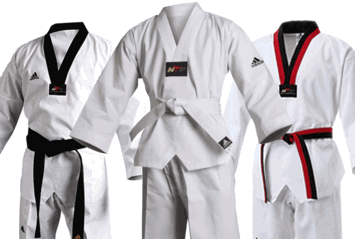
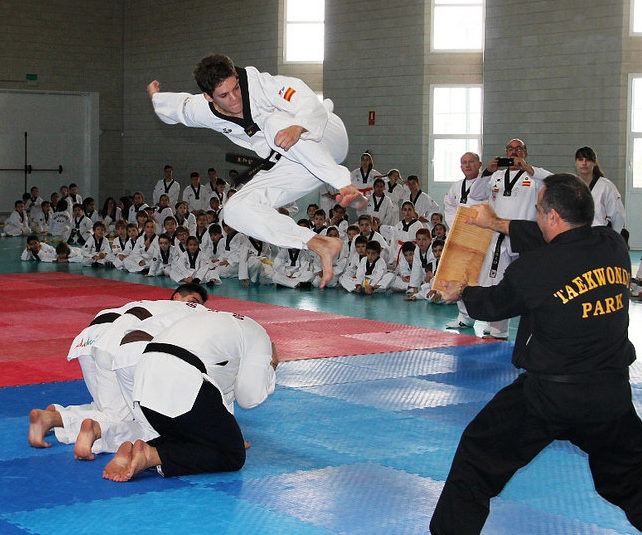

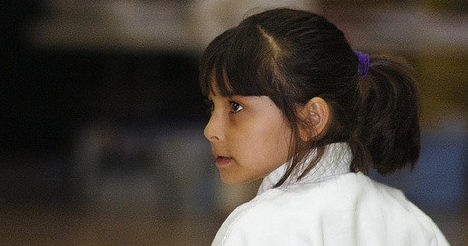
 As a clinical psychologist, I find myself looking at the deeper meanings of what my students and clients say and do. For example, how often have we heard a child say “this is easy” while they can barely complete the training drill. This is typically a healthy, normal response in order to maintain our ego or belief that we are “good.” However, the problem lies that this behavior does not demonstrate integrity and can lead to further self deception that limits our ability to improve our skills by learning from our weaknesses. With that said, lets explore the meaning of integrity more and how slight changes in our mindset can make a huge difference in our performance, wellness and lead to excellence.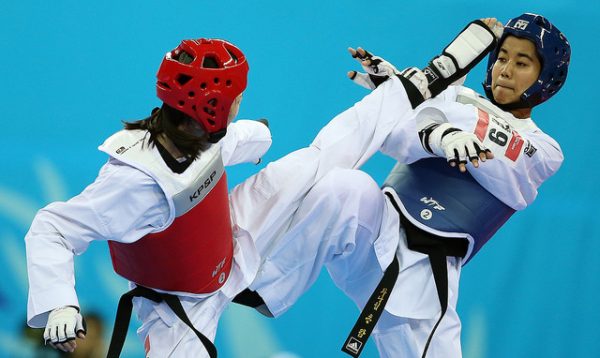
 When I enrolled in my first Taekwondo class, I remember instructors expressing a strong emphasis on self control. At that time, in my youth, I understood self control to be strictly about being able to control my body in such a way that it would display balance, power, speed, and accuracy. I have come to discover with my clinical psychology education and my continued Taekwondo training, that our ability to control our body movements is just the physical portion of self control. There is an entire other portion that is rarely discussed during Taekwondo training, the mental portion.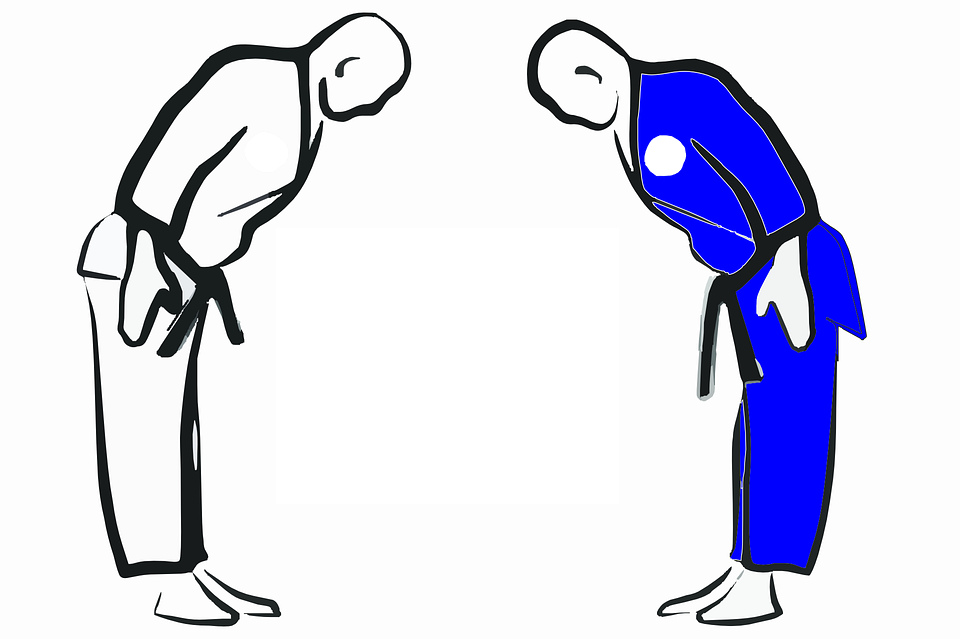
 In just about every martial arts class students line up at the beginning of class to salute the flags and their instructor. This tradition teaches students to honor their specific martial art heritage and respect their instructor. Courtesy is one of the tenets of Taekwondo and I would argue that it also teaches students the value of respecting themselves and improving their own mental health while they are at it.