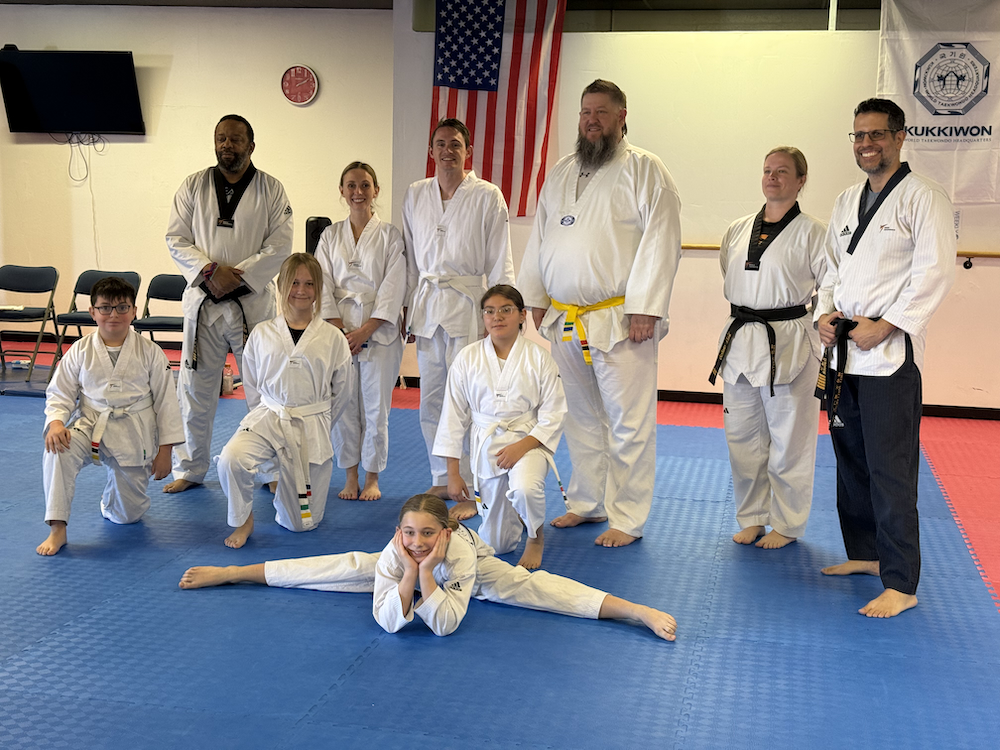
At TKD Wellness, our mission is to improve the mental and physical health of our community through the vehicle of Olympic sport Taekwondo. While parents often see their children practicing “forms” or “kicking pads,” what is actually occurring on the mat is a sophisticated form of psychological conditioning. Every movement in our curriculum is designed to foster empowerment, a core value of our facility that focuses on mental skills like stress management and the development of a growth mindset.
Poomsae: The Architecture of Discipline and Focus
Poomsae (forms) are more than just a sequence of movements; they represent a unification of the spirit and the body. From a psychological perspective, practicing Poomsae is an exercise in Deliberate Practice, the process of learning from mistakes with the specific intention of improving skill.
The Mental Mechanics of Poomsae
- Self-Control (Geuk Gi): This tenet of Taekwondo is the bedrock of discipline. It involves exercising restraint over impulses and maintaining control over one’s body. During Poomsae, a student must resist the urge to rush, instead focusing on the synchronization of breath and action.
- Focus and Awareness: Poomsae requires an intense “Gaze” (direction of movement) and “Intensity” (control of strength). This trains Awareness, the mental skill of knowing what one is thinking or feeling in the present moment.
- Executive Function: Research suggests that the complex motor patterns required in traditional martial arts forms enhance “executive functions,” such as inhibitory control and working memory (Diamond, 2013).
Sparring: Forging Confidence and Focus Under Pressure
While Poomsae is a solitary pursuit of perfection, Olympic sport sparring is a dynamic environment that demands Indomitable Spirit (Baekjul Boolgool), the courage to persist despite fear or hesitation.
The Psychology of the Match
- Confidence through Competence: At TKD Wellness, we teach that confidence is not a fixed trait; it is built through small accomplishments during regular training. In sparring, successfully executing a pada chagi (counter kick) or maintaining focus during a high-pressure exchange builds self-efficacy.
- Energy Management: High-level sparring requires the athlete to find their “optimum” level of energy. If a student is too anxious, their performance suffers; if they are too relaxed, they lack the necessary speed. Sparring teaches athletes to proactively regulate their energy levels to stay in the “zone”.
- Mindfulness in Motion: Focus in sparring is vital for safety and success. We train students to focus on the actions that lead to a desired outcome rather than on emotions like fear, which can leave an athlete “frozen”.
The Growth Mindset Bridge
Whether practicing the Taegeuk forms or stepping into the ring, our students are taught a Growth Mindset: the belief that their traits can be developed with effort and hard work. We view every “failed” kick or “forgotten” Poomsae step as an opportunity to learn, grow, and get stronger. This resilience is the ultimate goal of TKD Wellness, equipping our students with the mental tools to succeed not just in the dojang, but in life.
Coach’s Corner
For Parents:
- Acknowledge Effort, Not Just Skill: When your child completes a Poomsae, instead of saying “You’re so talented,” try “I love how much focus you put into that low block.” This reinforces a growth mindset.
- Normalize Sparring Nerves: If your child is nervous about sparring, help them use Reframing. Instead of seeing nerves as “fear,” help them see it as their body “getting ready for action”.
For Athletes:
- Practice Instructional Self-Talk: During Poomsae, use mental cues like “chamber” or “balance” to keep your focus sharp.
- Utilize Imagery: Spend 5 minutes before bed visualizing yourself sparring with confidence. Your brain cannot distinguish between a vivid mental image and a live event, meaning you are literally training while you rest.
Ready to experience the benefits of training firsthand? Sign up for a free class at TKD Wellness today.
Can’t make it to the dojang? Check out our comprehensive online Beginners Taekwondo Course on Udemy.
Follow us on YouTube or Facebook!
Written by AI & Reviewed by Clinical Psychologist and Head Coach: Yoendry Torres, Psy.D., 5th Dan
Disclaimer: Please note that some blog posts may contain affiliate links and TKD Wellness will earn a commission if you purchase through those links at no additional cost to you. We use all of the products listed and recommend them because they are companies or products that I have found helpful and trustworthy. Our website is supported by our users.