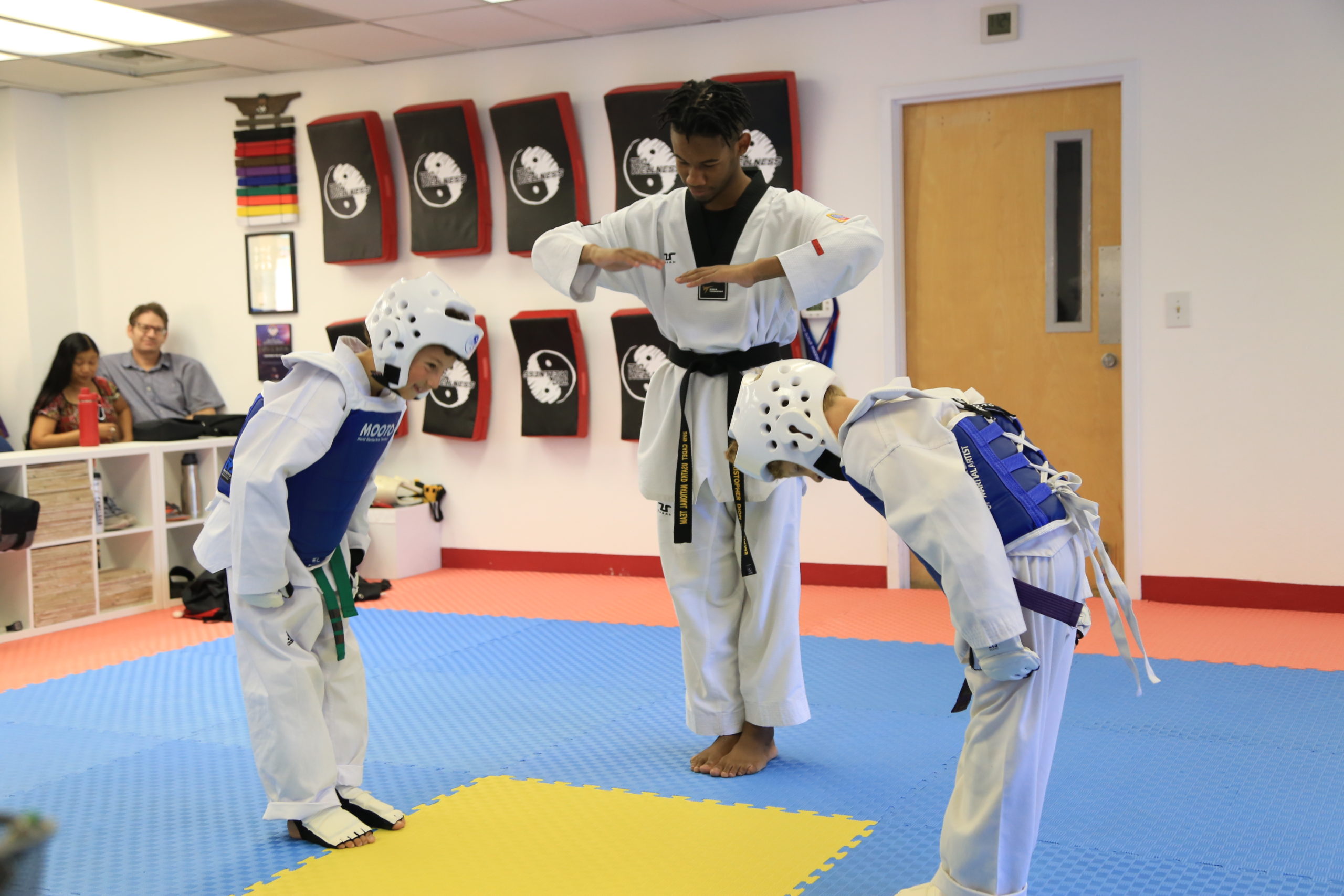
In pediatric psychology, one of the most foundational social-emotional milestones is the development of body autonomy and spatial awareness. For children, understanding where their personal space ends and another person’s begins is not always intuitive. It is a learned skill that requires dynamic practice, self-control, and heightened body awareness.
In the dojang (training hall), physical boundaries are not abstract social concepts, they are live, interactive experiences. Olympic sport Taekwondo provides a structured, safe environment where kids physically and mentally practice setting, respecting, and defending personal space. Here is how the lessons learned on the mat translate directly into essential life skills at home, at school, and on the playground.
The Science of Personal Space: Dynamic Spatial Awareness
In human psychology, personal space is governed by our internal map of “peripersonal space,” the bubble of space directly surrounding our bodies that our brains treat as an extension of ourselves. When a child struggles with motor planning or impulse control, they often invade others’ personal space, not out of malice, but because their sensory and spatial mapping systems are still maturing.
Taekwondo accelerates this neural development through distance management (geori jojeol). Every time a child steps onto the mat, they must constantly calculate distance:
Inside the Dojang: Whether executing a Poomsae (form) without colliding with a classmate or measuring the exact length of a front leg round kick (Ap Bal) to touch a target without overextending, students learn to read distance down to the millimeter.
Outside the Dojang: This refined spatial awareness translates directly to classroom and playground settings. Children who master distance in training naturally learn to stand in line without bumping into peers, respect personal physical bubbles during play, and recognize when they are crowding someone else.
Cultivating Body Autonomy and Consent Through Controlled Contact
Learning physical boundaries requires understanding consent and physical autonomy. Children must learn two distinct sides of this rule: respecting someone else’s “no” and feeling empowered to enforce their own.
Taekwondo instills these boundaries through strict protocols of mutual respect (Ye Eui) and self-control (Geuk Gi):
Structured Touch: Martial arts training is not a free-for-all. Every contact drill is bound by explicit rules. Before sparring or practicing pad drills, students bow to their partners. This traditional gesture acts as a formal contract of mutual safety and respect.
The Power of the Kihap (Yell): When a child projects a loud, energetic kihap during a kick, they are not just releasing physical power, they are practicing vocal empowerment. We teach children that their voice is their first line of defense.
Calibrated Contact: Through controlled drills, children learn the difference between safe, intentional touch (holding a kicking target for a partner) and unsafe, non-consensual contact. They learn that their body belongs to them, and they must hold absolute control over how they use it.
Emotional Regulation: Managing the Impulse to Intrude
Boundary violations among children often stem from a lack of emotional regulation or high impulsivity. When a child gets overly excited, they may grab, push, or rush into someone else’s space.
Taekwondo targets this through the integration of mindfulness and energy management. At the end of every training session, students engage in short mindfulness meditation to lower their heart rate, reset their nervous systems, and process the physical energy of class.
Research in sport psychology highlights that integrating mindfulness with physical exercise significantly improves executive functioning, inhibitory control, and emotional self-regulation in youth. By teaching children how to down-regulate their energy on command, they gain the impulse control required to pause, read a social situation, and respect others’ physical limits even when excited.
Coach’s Corner: Actionable Tips for Parents
To help your child bridge the gap between their Taekwondo training and their daily life, try these simple reinforcing strategies at home:
Use Taekwondo Terminology at Home: If your child is standing too close or invading a sibling’s space, avoid vague commands like “stop annoying your brother.” Instead, use Taekwondo concepts: “Check your geori jojeol (distance control)” or “Notice your partner’s personal space.”
Practice the “Stop Stance”: Teach your child to use a firm walking stance (Ap Seogi) with open, outstretched hands while saying a calm, strong “Stop” if someone invades their bubble. Practice this as a non-aggressive, confident boundary-setting tool.
Reinforce the “3-Second Rule”: Just as we teach in sparring drills, encourage your child to pause for three seconds and evaluate their surroundings before rushing into a crowded group or jumping into someone’s play area.
Ready to experience the benefits of training firsthand? Sign up for a free class at TKD Wellness today.
Can’t make it to the dojang? Check out our comprehensive online Beginners Taekwondo Course on Udemy.
Follow us on YouTube or Facebook!
Written by AI & Reviewed by Clinical Psychologist and Head Coach: Yoendry Torres, Psy.D., 5th Dan
Disclaimer: Please note that some blog posts may contain affiliate links and TKD Wellness will earn a commission if you purchase through those links at no additional cost to you. We use all of the products listed and recommend them because they are companies or products that I have found helpful and trustworthy. Our website is supported by our users.