As both a clinical psychologist and a 5th Degree Black Belt, my life’s work centers on bridging the gap between high-level martial arts training and psychological well-being. At TKD Wellness, our classes are intentionally built upon three pillars: fun, fitness, and empowerment. While the physical conditioning strengthens the cardiovascular system and prepares the body for athletic performance, the mental skills we introduce on the mat are what truly empower our students to thrive out in the world.
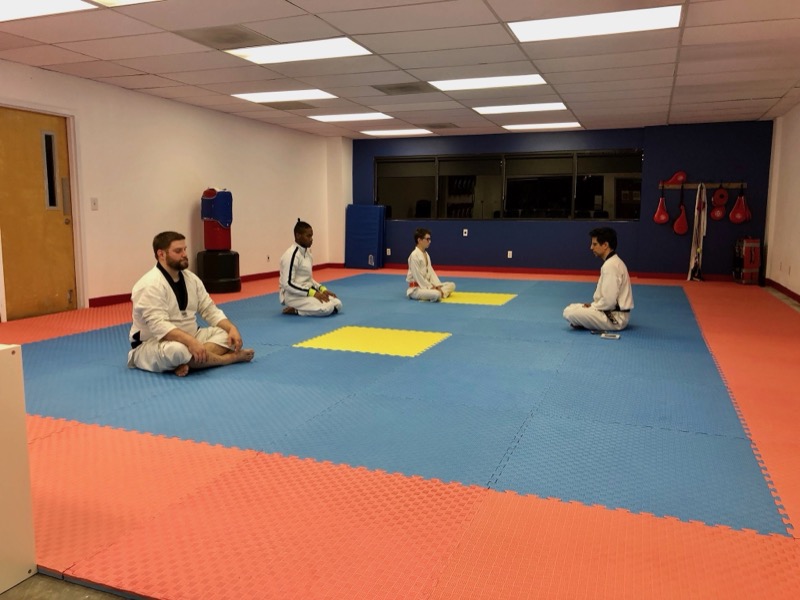
One of the most vital components of our curriculum occurs during the final minutes of every single training session. While the high-intensity Olympic sparring drills and rigorous Poomsae repetitions demand outward expressions of power, we conclude our classes by turning inward. We dedicate the final two minutes of every class strictly to formal mindfulness meditation.
To the untrained eye, it looks like a simple moment of quiet after a hard workout. In reality, it is a scientifically backed sport psychology intervention designed to optimize cognitive functioning, enhance emotional regulation, and accelerate physiological recovery.
Understanding the Practice: What is Mindfulness?
In our dojang, we define mindfulness through the framework established by pioneer Jon Kabat-Zinn: “Mindfulness means paying attention in a particular way: on purpose, in the present moment, and non,judgmentally”.
During our post-training meditation, students assume a comfortable seated position, close their eyes, and anchor their awareness to the natural rhythm of their breath. When their minds naturally begin to wander, bring up random thoughts, or notice background sounds, the directive is simple: notice the distraction without judgment or criticism, and gently guide the attention back to the breath.
This simple act of getting distracted and returning focus is not a failure of meditation, it is the exact mechanism that builds psychological strength. It is a cognitive repetition, a push-up for the brain.
Sharpening Focus for School and Work
Many parents enroll their children in Taekwondo to improve their focus at school, just as adult professionals join us to find an edge in their careers. The cognitive cross-training of our post-class meditation directly facilitates this outcome.
When a student practices noticing a wandering mind and intentionally redirecting it back to their breathing, they are strengthening their capacity for sustained attention. According to empirical research synthesized by the American Psychological Association (APA), regular mindfulness practice provides documented boosts to working memory and significantly enhances cognitive flexibility.
When a child is sitting at a school desk or an adult is tackling a complex project at work, distractions are inevitable. However, because they have spent months practicing the cognitive loop of “distract, notice, and return” on the mat, they possess the mental discipline to pull their awareness away from internal or external distractions and place it right back onto the task at hand. They gain the ultimate cognitive power: the ability to focus attention on what they choose, rather than where the brain defaultly drifts.
Cultivating Self-Compassion: Learning to Be Kinder to Yourself
In both Olympic sport Taekwondo and modern professional spaces, individuals frequently grapple with perfectionism and the destructive impact of negative self-talk. Following a mistake on the mat, a missed promotion, or a poor grade on an exam, many individuals fall into patterns of harsh self-criticism.
The “non-judgmental” component of mindfulness acts as the ultimate psychological antidote. By teaching students to observe their wandering minds, stray thoughts, and uncomfortable emotions “without judgment or criticism,” we break the habit of secondary emotional reactivity. Students learn to observe a mistake as an objective piece of data rather than an indictment of their self-worth.
Sport psychology literature confirms that this mindful, non-judgmental awareness reduces rumination, the toxic cycle of overthinking past errors. By learning to accept the present moment exactly as it is without self-punishment, students cultivate a resilient growth mindset. They learn to treat themselves with the same courtesy and respect they are required to show their coaches and peers.
Energy Management: The Art of Calming Down Quicker
Physiologically, high-level martial arts training spikes the sympathetic nervous system, leaving the body in a high-energy, “fight-or-flight” state. However, elite performance, and overall health, requires effective energy management: the ability to proactively regulate our psychological and physiological states to match our environment.
Our two-minute meditation serves as a deliberate down-regulation protocol. By transitioning immediately from rigorous movement to slow, rhythmic deep breathing, students actively stimulate the parasympathetic nervous system. This intentional focus lowers the heart rate, reduces blood pressure, and mitigates feelings of acute stress and anxiety.
Over time, this trains the body’s nervous system to recover and bounce back from physical and emotional exertion rapidly. Our students don’t just leave the dojang physically exhausted, they leave with their heart rates controlled, their minds cleared, and their bodies relaxed, ready to transition smoothly into a restful evening at home.
Coach’s Corner: Bringing the Mat Home
To maximize the benefits of our post,class mindfulness routine, the mental skills built in the dojang must be integrated into daily life. Here is how parents and athletes can utilize these principles at home:
For Parents: Create an informal mindfulness transition ritual before homework or study sessions. Have your child close their eyes and take three slow, deep “dragon breaths” to lower their energy levels and clear away school-day distractions before opening their books. If they make a mistake and get frustrated, gently remind them to pause, take a breath, and look at the error without criticism.
For Olympic Athletes: Do not skip the cool-down. Use formal mindfulness meditation to manage pre-competition pressure. When the mind begins racing with performance anxiety before a big match, spend two minutes focusing strictly on your breath. This grounds your awareness in the present moment, drops your energy into your “optimum zone,” and allows your body to react automatically using the skills you have deliberately practiced.
Ready to experience the benefits of training firsthand? Sign up for a free class at TKD Wellness today.
Can’t make it to the dojang? Check out our comprehensive online Beginners Taekwondo Course on Udemy.
Follow us on YouTube or Facebook!
Written by AI & Reviewed by Clinical Psychologist and Head Coach: Yoendry Torres, Psy.D., 5th Dan
Disclaimer: Please note that some blog posts may contain affiliate links and TKD Wellness will earn a commission if you purchase through those links at no additional cost to you. We use all of the products listed and recommend them because they are companies or products that I have found helpful and trustworthy. Our website is supported by our users.