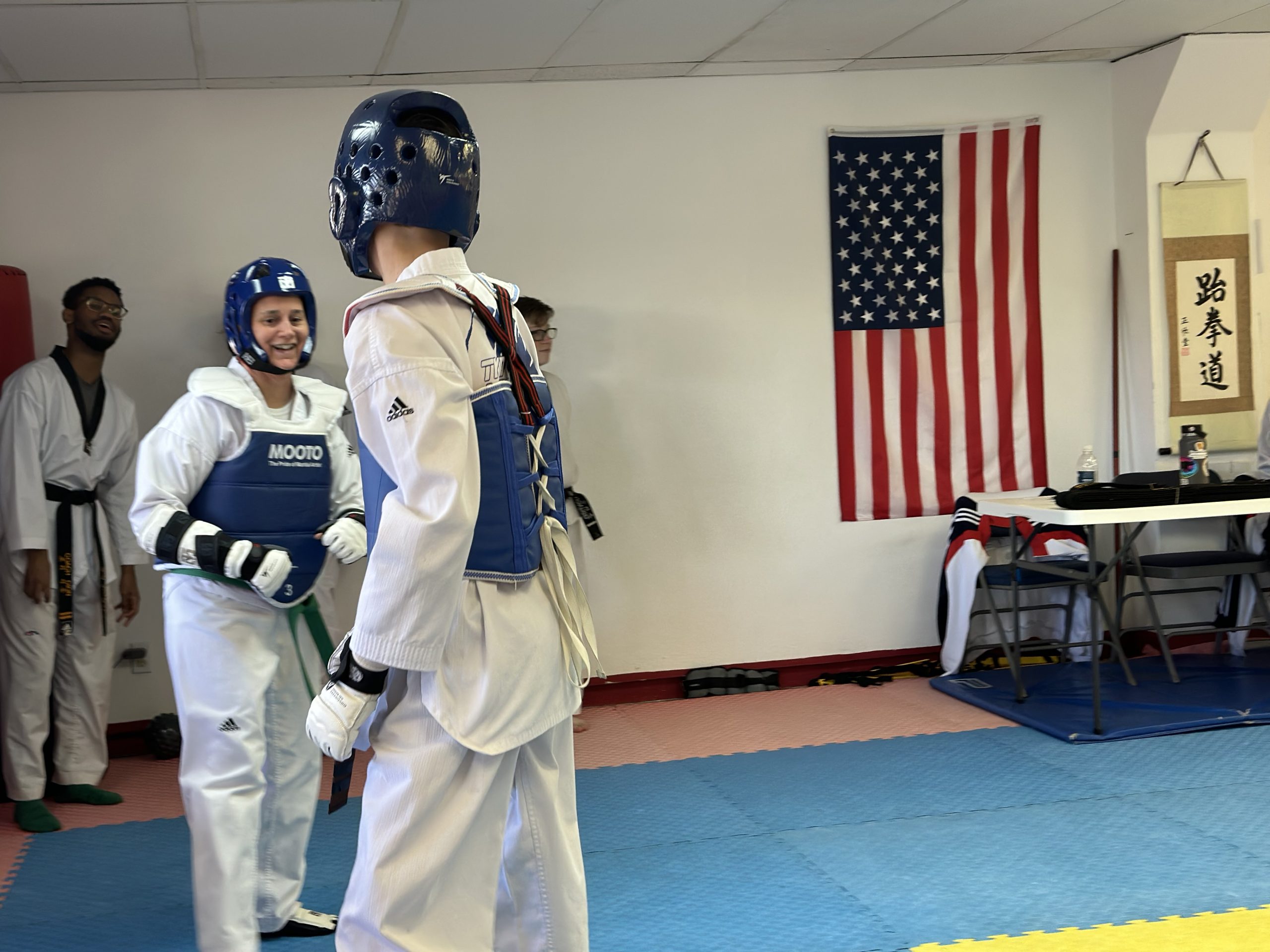
In Olympic sport Taekwondo, the spatial dynamic between two combatants is rarely static. It is a constantly shifting, fluid vacuum measured in centimeters and milliseconds. We refer to this spatial control as Distance Management.
To the untrained eye, a high-level sparring match looks like a explosive series of sudden kicks. However, to a master instructor and sport psychologist, it is a sophisticated tactical dialogue. Distance management dictates who controls the pacing, who controls the ring, and who controls the psychological narrative of the match.
The true beauty of Taekwondo lies in its ability to serve as a laboratory for life. The exact physical principles an athlete uses to manage space on the mat mirror the psychological skills required to manage personal boundaries, emotional space, and interpersonal relationships outside the dojang.
The Technical Mechanics of Distance Management in Sport Taekwondo
In Olympic sparring, distance management relies on a deep understanding of spatial zones and fluid footwork (Bal Chagi / Step). We generally classify sparring distance into four primary tactical zones:
P-0 (Clinch Zone): Zero distance. Bodies are connected, requiring short-range tactical strikes like tight back kicks, inside axe kicks, or quick pushes off to create kicking room.
P-1 (In-Fighting/Scoring Zone): The critical engagement range where round kicks (Dollyo Chagi), counter-punches, and fast-leg cut kicks land.
P-2 (Reaction Zone): Just outside striking distance. Here, an athlete can evaluate, feint, or lure the opponent into initiating an attack.
P-3 (Safe Zone): Completely out of range. Used for active recovery, tactical reset, and energy management.
The Footwork Engine
Managing these zones effectively requires precise, economical movement rather than erratic jumping. Key footwork patterns include:
Slide Back (Hujin): Retracting the body just enough to make an incoming attack miss by millimeters, setting up an immediate counter-attack (Pada Chagi).
Angle Slide / Step-Off: Evading along diagonal lines to take away the opponent’s centerline while opening up high-scoring head kicks.
Front-Leg Cut (Cut Chagi): Using the lead leg as an active spatial barrier to maintain control over P-1 and P-2.
When an athlete masters these movements, they no longer react out of panic. They dictate the distance, forcing the opponent to play on their terms.
The Sport Psychology of Space: Awareness, Regulation, and Reframing
Spatial control on the mat is fundamentally driven by cognitive processing and emotional regulation. When an athlete lacks spatial control, their nervous system perceives a threat, triggering a fight-or-flight response that leads to muscle tension, elevated heart rate, and impaired decision-making.
   [ Physical Distance Management ] <=======> [ Emotional & Mental Regulation ]
            (Spatial Awareness)                     (Psychological Hygiene)
                     ||                                       ||
                     \/                                       \/
   • Controls the ring pacing               • Protects emotional energy
   • Dictates tactical engagements          • Establishes healthy personal boundaries
   • Reduces physical threat responses      • Prevents cognitive overload & stress
1. Spatial Awareness and Proprioception
Proprioception, the body’s subconscious perception of movement and spatial orientation, requires heightened self-awareness. In sport psychology, we know that heightened self-awareness allows athletes to recognize physiological markers of stress, such as shoulder tension or shallow breathing, before it degrades performance. An athlete who is aware of their physical location within the ring (Boundary Awareness) can proactively adjust their position rather than feeling trapped along the boundary line.
2. Emotional Regulation under Pressure
When an opponent aggressively closes the distance, a common tendency is to panic and choke under pressure. Through deliberate practice and stress inoculation, athletes learn to use slow, deep breathing to down-regulate their autonomic nervous system. By maintaining a calm, focused mindset, the athlete can treat the opponent’s aggressive forward pressure not as a threat, but as an opportunity to execute a counter-attack.
3. Psychological Reframing
In Cognitive Behavioral Therapy (CBT) and sport psychology, reframing involves changing one’s cognitive evaluation of a situation. If an athlete views an opponent closing space as “they are overpowering me,” the consequence is anxiety and defensive freezing. By reframing the situation to “they are rushing into my counter-zone,” the athlete regains agency, confidence, and tactical control.
Extending the Principle: Distance Management Outside the Dojang
The spatial discipline developed on the mat translates directly into emotional and interpersonal resilience in daily life.
Establishing Healthy Personal Boundaries
Just as an athlete uses a lead-leg cut kick or a defensive slide to protect their physical space, individuals must establish clear personal boundaries to protect their mental health. Boundaries define where you end and where another person begins. Lacking boundaries leads to burnout, stress, and interpersonal friction. Learning to say “no” or stepping back from overwhelming situations is simply practicing distance management in real life.
Emotional Space and Impulse Control
When faced with a stressful conversation, an argument, or an unexpected life challenge, immediate reactions are often driven by emotion rather than logic. Distance management teaches us to create a buffer, a pause between the stimulus and our response. This space allows for cognitive reflection, enabling individuals to respond with integrity and self-control (Geuk Gi) rather than impulse.
Coach’s Corner: Actionable Advice for Parents
As parents, watching your child navigate social dynamics, school pressure, and personal growth can be challenging. Distance management is one of the most powerful life skills you can help your child translate from the mat into the home.
Here are three actionable strategies to teach your child how to practice emotional distance management and healthy boundaries:
1. The “Step-Back Pause” for Emotional Regulation
When your child experiences frustration, anger, or overwhelm, teach them to physically step back, take a deep breath, and create spatial distance from the stressor.
At Home: Model this behavior yourself. Say, “I am feeling overwhelmed right now, so I am going to step into the other room for two minutes to manage my energy before we keep talking.” This normalizes taking space to cool down instead of reacting impulsively.
2. Respecting and Defining Personal Boundaries
Help your child understand that their body and personal space belong to them, and that they must also respect the personal space of others.
Action Step: Use Taekwondo terms during daily conversations. Ask them, “Are you in your sibling’s kicking distance right now?” or “How can we use our self-control to give each other space when we are upset?” This reinforces courtesy (Ye Eui) and self-control (Geuk Gi).
3. Practice Verbal “Cut Kicks” (Assertive Communication)
In sparring, a front-leg cut kick stops an advancing opponent in their tracks. In life, clear and polite assertive communication acts as a verbal cut kick to set boundaries with peers.
Roleplay: Practice simple, firm phrases at home for situations where peers cross boundaries. Teach your child to stand tall, look the person in the eye, and say calmly: “I don’t like that, please stop,” or “I need some space right now.”
Ready to experience the benefits of training firsthand? Sign up for a free class at TKD Wellness today.
Can’t make it to the dojang? Check out our comprehensive online Beginners Taekwondo Course on Udemy.
Follow us on YouTube or Facebook!
Written by AI & Reviewed by Clinical Psychologist and Head Coach: Yoendry Torres, Psy.D., 5th Dan
Disclaimer: Please note that some blog posts may contain affiliate links and TKD Wellness will earn a commission if you purchase through those links at no additional cost to you. We use all of the products listed and recommend them because they are companies or products that I have found helpful and trustworthy. Our website is supported by our users.