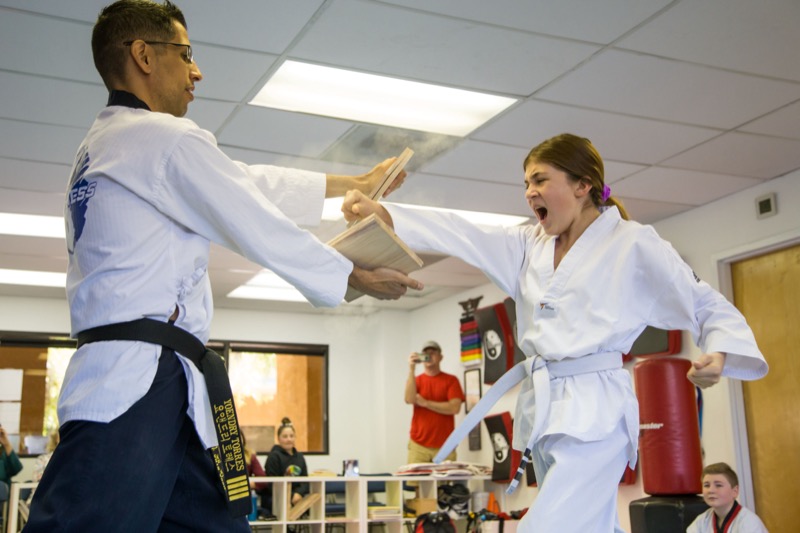
As a clinical psychologist and 5th Degree Black Belt, I often remind parents that martial arts training is far more than physical self-defense. It is a structured psychological environment designed to cultivate self-regulation, resilience, and personal empowerment. This week at TKD Wellness, our “Skill of the Week” focus centers on Verbal Defense, specifically examining how the confidence forged on the mat empowers youth ages 8 to 17 to set firm boundaries, assert themselves, and navigate challenging social dynamics outside the dojang.
The Physiology of Assertiveness: The Kihap as a Verbal Boundary
In Olympic Taekwondo, one of the first core concepts a student learns is the Kihap (martial shout). From a technical standpoint, a proper kihap synchronizes diaphragmatic breathing with muscular contraction at the point of impact, optimizing power output and protecting the torso. However, from a sport psychology perspective, the kihap serves as a primary tool for energy management and emotional regulation.
When youth face bullying, peer pressure, or boundary violations, their nervous systems often default to a freeze response, characterized by shallow breathing, muscle tension, and voice suppression. Practicing a vocal, confident kihap in class functions as a form of stress inoculation. It conditions the young athlete to find their voice under pressure. By learning to up-regulate their energy and project their voice with intention on the mat, youth train their nervous system to overcome the freeze response. This vocal confidence directly transfers to real-world scenarios where they must state a clear, firm “No” or “Stop” to peers or aggressors.
Emotional Regulation and Mindful Boundary Setting
Assertiveness is not aggressiveness; it requires a high level of emotional regulation. High-intensity sparring drills and poomsae practice naturally elevate heart rates and induce physiological arousal. Through structured training and post-class mindfulness meditation, we teach students to recognize their internal energy levels and down-regulate when emotions or stress run high.
Research in developmental psychology shows that adolescents who possess strong emotional regulation skills demonstrate higher levels of social self-efficacy and assertive communication. When youth learn to manage their internal state during intense physical engagement, they develop the self-control necessary to respond thoughtfully rather than react impulsively in conflict. They learn that setting a boundary does not require anger or escalation; it simply requires a clear, controlled, and unshakeable presence.
+-----------------------------------------------------------------------------------+
|                        THE VERBAL DEFENSE SPECTRUM                                |
+-----------------------+----------------------------------+------------------------+
| Communication Style   | Internal State                   | Outcome                |
+-----------------------+----------------------------------+------------------------+
| Passive               | Freeze response, high anxiety    | Boundaries overridden  |
| Aggressive            | Unregulated emotional arousal    | Conflict escalates     |
| Assertive (TKD Style) | Regulated energy, grounded presence | Clear boundary set  |
+-----------------------+----------------------------------+------------------------+
Coach’s Corner
For parents of youth ages 8 to 17, reinforcing verbal defense at home helps bridge the gap between dojang practice and daily life. Here are three actionable strategies to build assertive boundary setting:
Practice the “Kihap Posture” at Home: Encourage your child to practice a strong, balanced stance (Jumbeestance) with open chest, eye contact, and a firm voice when expressing needs or resolving disagreements. Physical posture directly influences psychological feeling states and vocal delivery.
Normalize Energy Down-Regulation: When high-stress moments or conflicts happen at home, guide your child to practice deep, slow breathing, the exact technique we use during post-class meditation, to lower their heart rate before addressing the issue.
Role-Play Boundary Scenarios: Use low-stakes scenarios (e.g., declining an uncomfortable request from a peer, asking someone to respect personal space) to let your child practice saying “No” with a calm, clear tone. Praise their effort and vocal clarity to reinforce a growth mindset.
Ready to experience the benefits of training firsthand? Sign up for a free class at TKD Wellness today.
Can’t make it to the dojang? Check out our comprehensive online Beginners Taekwondo Course on Udemy.
Follow us on YouTube or Facebook!
Written by AI & Reviewed by Clinical Psychologist and Head Coach: Yoendry Torres, Psy.D., 5th Dan
Disclaimer: Please note that some blog posts may contain affiliate links and TKD Wellness will earn a commission if you purchase through those links at no additional cost to you. We use all of the products listed and recommend them because they are companies or products that I have found helpful and trustworthy. Our website is supported by our users.