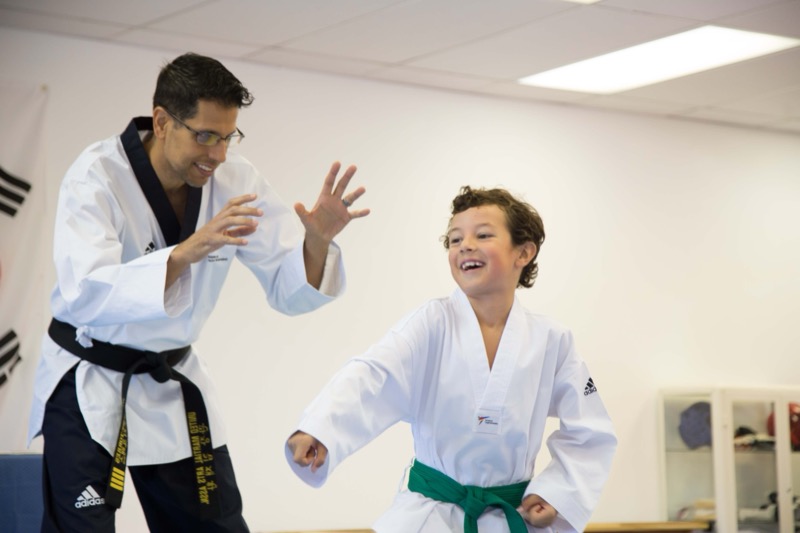
As both a clinical psychologist and a 5th Degree Black Belt, I am frequently asked by parents if learning martial arts will teach their children how to fight. My answer often surprises them: the primary goal of elite Taekwondo training is to teach children how not to fight.
While parents naturally want their children to possess the physical skills to protect themselves, the most powerful tool in any martial artist’s arsenal is not a spinning hook kick or a power punch. It is the ability to de-escalate a high-stress confrontation before a single strike is thrown. Teaching de-escalation is far more than a physical self-defense protocol; it is a foundational life skill rooted in emotional intelligence, emotional regulation, and empathic reflection that transforms how our young athletes navigate the world, both inside and outside the dojang.
The Psychology of De-Escalation: Emotional Regulation Under Fire
To understand de-escalation, we must first look at what happens to a child’s brain during a conflict. When faced with aggression, a confrontation at school, or an intense disagreement on the playground, the brain’s threat-detection center, the amygdala, triggers a classic “fight, flight, or freeze” response. Blood rushes away from the prefrontal cortex, the center responsible for logic, reasoning, and impulse control, leaving the child driven purely by heightened emotional reactivity.
In Taekwondo, we intentionally expose students to controlled physical and mental stressors, a concept known as stress inoculation. Through deliberate practice, students learn to recognize the physiological warning signs of acute stress, such as a racing heart rate, muscle tension, or shallow breathing.
This awareness is where true Geuk Gi (self-control) begins. By pairing physical boundary management with down-regulation techniques like deep, controlled diaphragmatic breathing, children learn to quiet the amygdala and keep their prefrontal cortex online. A child who can regulate their own nervous system under pressure gains the mental clarity needed to manage another person’s heightened energy.
The Art of Empathic Reflection: Lowering the Temperature
Once a child achieves personal emotional regulation, they can utilize the most advanced psychological de-escalation tool available: empathic reflection.
When a classmate or peer approaches with anger, that aggression is almost always rooted in a feeling of being unheard, threatened, or misunderstood. An untrained reaction is to counter-attack (matching aggression with aggression) or shut down. Both responses escalate the conflict.
Through empathic reflection, we teach our young martial artists to de-escalate by helping the distressed individual feel heard and understood. This involves three core steps:
Non-Threatening Stance and Space Management (Gauging Distance): The student adopts an open, non-aggressive stance. In Taekwondo sparring, we call this managing distance (P-zero to P-four awareness). Physically step back to grant personal space while keeping hands up at chest level in an open, non-confrontational palm position. This signals safety rather than challenge.
Active Listening and Validation: Instead of arguing the facts immediately, the student validates the underlying emotion. Phrases such as, “I can see that you are really upset right now,” or “It sounds like you’re angry because you thought I took your turn,” serve an essential function.
Reframing and Calming the Environment: Validation does not mean agreeing with wrong behavior; it means acknowledging the emotional reality of the other person. When an upset child feels their emotion has been accurately perceived and reflected, their brain’s perception of a threat decreases, causing their energy levels to down-regulate naturally.
From the Mat to Main Street: A Skill Set for Life
The benefits of mastering de-escalation reach far beyond avoiding a physical altercation. The exact same mechanisms a child uses to diffuse a bully are the ones they will rely on throughout their adolescent and adult lives:
Academic and Peer Relationships: Children equipped with emotional intelligence navigate group dynamics, playground misunderstandings, and peer pressure with confidence and grace.
Family Harmony: At home, a child who understands emotional regulation and empathic reflection is far better equipped to navigate sibling rivalry and express their own needs without resorting to tantrums or hostility.
Future Professional Edge: Conflict is an inevitable part of adulthood. Adults who learned to remain calm, listen empathetically, and de-escalate situations as children grow up to become exceptional leaders, communicators, and resilient problem-solvers.
Conflict Arises -> Stress Inoculation / Self-Control -> Down-Regulation (Breathing) -> Empathic Reflection -> De-Escalation
Coach’s Corner: Actionable De-Escalation Steps for Parents
As parents, we are our children’s primary coaches in emotional intelligence. Here are three actionable strategies you can practice at home this week to reinforce our dojang “Lesson of the Week” on de-escalation:
1. Model “Dragon Breathing” During Moments of Tension
When frustration arises at home (e.g., rushed mornings, homework meltdowns), model physical down-regulation out loud. Take a deep, slow inhale through the nose and a long exhale through the mouth, saying, “I’m feeling a bit frustrated right now, so I’m going to take a dragon breath to keep my mind calm before we figure this out.”
2. Practice the “Mirroring Game”
Role-play minor conflicts with your child using empathic reflection. Act out a scenario where you act upset (e.g., “You took my favorite toy!”), and coach your child to respond using a calm voice and reflective language: “I hear that you’re upset because you wanted to play with that toy.” Show them how quickly your “upset character” calms down when heard.
3. Praise the Pause
When you observe your child choosing self-control over an angry reaction, whether with a sibling or a friend, provide immediate, effort-focused praise. Try saying: “I noticed how you took a deep breath and spoke calmly when your brother took your game. That showed incredible self-control and maturity!”
Ready to experience the benefits of training firsthand? Sign up for a free class at TKD Wellness today.
Can’t make it to the dojang? Check out our comprehensive online Beginners Taekwondo Course on Udemy.
Follow us on YouTube or Facebook!
Written by AI & Reviewed by Clinical Psychologist and Head Coach: Yoendry Torres, Psy.D., 5th Dan
Disclaimer: Please note that some blog posts may contain affiliate links and TKD Wellness will earn a commission if you purchase through those links at no additional cost to you. We use all of the products listed and recommend them because they are companies or products that I have found helpful and trustworthy. Our website is supported by our users.